A Low-Prep Way to Lead Meaningful Bible Study Conversations
This post contains affiliate links. Which means we may receive a commission for any purchases made through our links. As an Amazon Associate, I earn from qualifying purchases. See our full policy. Thank you for reading this post. Don't forget to subscribe!
Are you familiar with choice boards? Choice boards are usually talked about in classroom settings, but honestly. Their real magic shows up far beyond early finishers and schoolwork.
At the heart of it, a choice board simply gives people permission to engage in a way that feels right for them, and that’s exactly why they work so well in Bible study, women’s ministry, and retreat spaces.
If you’ve ever led a small group, you’ve probably seen this play out: a few people are always ready to talk, a few prefer to stay quiet, and sometimes the conversation just… stalls. Everyone’s there, but not everyone knows how to jump in. That’s where choice boards can really change the dynamic.

Instead of asking one question and hoping it lands for everyone, a choice board offers multiple entry points.
One person might want to journal quietly. Another might be ready to share out loud. Someone else might connect more deeply with a reflective prompt than a discussion question. Choice boards make room for all of that without putting anyone on the spot.
Teachers have been using choice boards for years to boost engagement and help students take ownership of their learning. In ministry spaces, that same idea creates room for deeper reflection, safer sharing, and more genuine conversation. Whether you’re leading a weekly women’s Bible study, planning a retreat session, or just looking for a flexible discussion tool that doesn’t require hours of prep, choice boards give you structure without feeling rigid or scripted.
Here we'll look at:
What choice boards are and why they work so well in faith-based groups
- What choice boards are and why they work so well in faith-based groups
- How to use them for Bible study, women’s ministry, and retreats
- Practical examples of Scripture-centered choice boards inspired by women of the Bible
If you’re looking for a way to encourage meaningful discussion while still honoring different comfort levels and learning styles, you’re in the right place.
What Is a Choice Board?
At its simplest, a choice board is a grid of prompts that allows participants to choose how they want to engage with a topic. Instead of everyone answering the same question in the same way, a choice board opens up multiple paths for reflection and conversation.
In classrooms, choice boards help students stay engaged and work more independently. In Bible study and ministry settings, they do something similar but on a heart level. When people are given choices, they’re more likely to participate thoughtfully instead of feeling pressured to respond a certain way.
In faith-based groups, choice boards often include prompts that encourage:
- Personal reflection
- Journaling
- Small-group discussion
- Scripture-based application
Each square offers a slightly different angle on the same theme, allowing participants to start wherever they feel most comfortable.
Why Choice Boards Work So Well in Bible Study & Ministry Groups
Ministry groups are made up of people with different personalities, backgrounds, and comfort levels. A single discussion question doesn’t always meet everyone where they are, but a choice board can.
Here’s why they work so well:
They give participants ownership.
When someone chooses their own prompt, they’re more invested in the conversation. That sense of choice often leads to more honest, thoughtful responses.
They lower the pressure to speak.
Not everyone processes faith out loud; I sure don't. Choice boards make space for quiet reflection and journaling alongside discussion, which is especially helpful in mixed groups.
They encourage deeper reflection.
Instead of quick or surface-level answers, well-written prompts invite people to pause, think, and connect Scripture to real life.
They’re flexible for leaders.
You can use choice boards individually, in pairs, or with the whole group. They adapt easily to different group sizes and time frames.
They offer structure without feeling stiff.
You don’t have to scramble for questions, but the conversation still feels natural, not forced or overly planned.
How to Use a Choice Board for Bible Study or a Retreat Session
One of my favorite things about choice boards is how adaptable they are. You don’t need special training, a long prep window, or a strict agenda. The same simple framework works whether you’re leading a weekly Bible study or facilitating a retreat session.
Step 1: Decide how you’ll use it.
Before your group meets, think about how participants will engage:
- Individually (quiet reflection or journaling)
- In pairs or small groups
- As a whole group, with you guiding the discussion
There’s no “right” way. Just choose what fits your group and the time you have.
Step 2: Set the tone early.
Let participants know:
- They can choose the prompt that speaks to them
- Sharing is always optional
- There are no right or wrong answers
This is especially important in women’s ministry and retreat settings, where people may not know each other well.
Step 3: Invite them to choose one prompt.
You can let people choose freely, assign prompts randomly, or rotate turns if you’re using the board more than once. Encourage a short pause before anyone speaks; even a minute or two of quiet reflection can deepen the conversation.
Step 4: Reflect, journal, or discuss.
Depending on your group, participants might:
- Write their thoughts down
- Share with the group
- Talk in pairs or small circles
Your role as facilitator isn’t to fill every silence; it’s to guide gently and listen well.
Step 5: Close with intention.
Wrap things up with a short reflection question, a Scripture reading, or prayer. This helps participants move from conversation to application and gives the session a sense of closure.
» Bonus tip: Many leaders customize prompts for a specific theme or event. Editable choice boards make it easy to adjust language, align with a retreat theme, or focus on a particular season of faith, so you can reuse the same format again and again..
Examples of Bible Study Choice Boards Inspired by Women of the Bible
One of my favorite ways to use choice boards is by centering them around women from Scripture. Their stories are full of real-life themes of courage, loyalty, obedience, identity, and trust that naturally invite reflection.
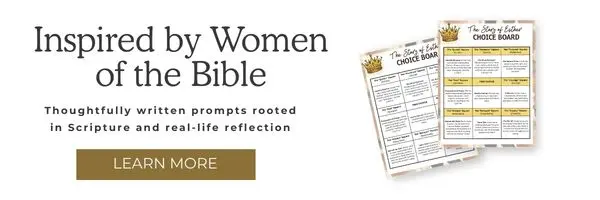
Esther Choice Board: Courage, Identity, and Trust
Esther’s story resonates deeply, especially in seasons where faith requires courage. An Esther-inspired choice board often invites reflection around:
- Making hard decisions without knowing the outcome
- Standing firm in identity and calling
- Trusting God’s timing over personal comfort
- Choosing obedience even when fear is present
These boards work beautifully for women’s Bible studies, leadership conversations, and retreat sessions focused on purpose or courage.
Ruth Choice Board: Loyalty, Obedience, and God’s Provision
Ruth’s story is especially meaningful for women walking through transition or uncertainty. A Ruth-inspired choice board creates space for gentler, more reflective conversation around:
- Loyalty in relationships
- Trusting God during change
- Obedience without a clear roadmap
- Recognizing God’s provision in unexpected places
This style of board works well for smaller groups and retreat settings where journaling or paired discussion feels more natural.
Story-based choice boards help people connect Scripture to their own lives without needing deep theological knowledge while still keeping God’s Word at the center.
Pro Tips for Facilitators Using Choice Boards
Choice boards are designed to make leading easier, but a few small facilitation choices can make a big difference.
- Remind participants they don’t need to “finish” the board. One prompt is enough.
- Normalize quiet moments; silence often leads to deeper insight.
- Always make sharing optional.
- Use Scripture as an anchor, not a lecture.
- Adjust the format to match your group’s energy and size.
- Close each session with intention prayer, reflection, or gratitude.
- Trust the process. Your role is to create space, not control outcomes.
How to Choose the Right Choice Board for Your Group
Think about:
- How familiar your group members are with each other
- Whether you’re meeting weekly or hosting a retreat
- What season of faith your group is in
- How much structure do you prefer as a facilitator
There’s no perfect choice board. Just the one that best supports the conversation your group needs right now.

How Editable Choice Boards Make Facilitation Easier
Editable choice boards give you the best of both worlds: a ready-made framework with room to personalize. You can tweak wording, align prompts with an event theme, or simplify questions for newer groups, all without starting from scratch.
They save time, reduce prep, and grow with your group over time.
Getting Started with Choice Boards
If you’re curious about trying choice boards, the best place to start is simple: use one board in one session and see how your group responds. Many leaders are surprised by how naturally the conversation flows once participants are given a choice.
I’ve created Scripture-centered, editable choice boards inspired by women of the Bible, specifically for women’s ministry, Bible studies, and retreats. They’re designed to be low-prep, flexible, and easy to return to again and again.
When you’re ready, you can explore the available choice boards and choose the one that feels like the best fit for your group.
And don't miss these creative ways to connect with scripture as well.
Sign up for my email list to receive a free kid-friendly paint party printable!

Enjoyed this post? Save and share it by pinning one of the images below.